King Lucius
Le Morte d'ArthurKing Lucius, the Roman emperor who demands tribute from Arthur, is the antagonist in the Roman campaign: he asserts an inherited imperial claim over Britain, assembles a far-reaching coalition when Arthur refuses, and dies in battle against him. His challenge transforms a question of overlordship into open war, while Arthur’s treatment of Lucius’s body turns the victory into a public counterclaim to Roman authority.
Imperial Demand and Diplomatic Rupture
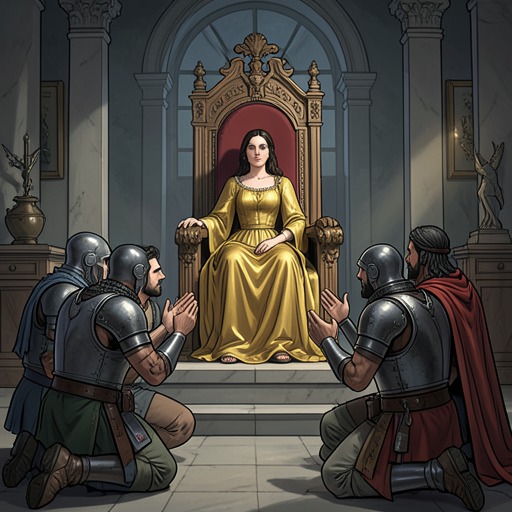
Lucius first enters the conflict through a formal embassy. After Arthur has rested from war and held a royal feast with allied kings, princes, and knights of the Round Table, twelve elderly messengers arrive bearing olive branches. They identify themselves as representatives of Lucius, then called Dictator or Procurator of the Roman Republic, and demand that Arthur recognize Lucius as his lord and send Britain’s customary tribute to the empire.
The ambassadors justify their demand by claiming that Arthur’s father and predecessors paid tribute and that Julius Caesar’s statutes and decrees establish Rome’s authority. They threaten war and punishment if Arthur refuses. Arthur does not let his young knights attack or insult the messengers: he orders that they be treated hospitably while he consults his council. This restraint distinguishes the diplomatic encounter from the violence that follows, even as the demand itself makes clear that Rome regards Arthur’s refusal as rebellion.
Arthur’s answer rejects both the obligation and the premise behind it. With his allies assembled, he declares that he owes no tribute to Lucius or to any earthly prince, Christian or heathen. He goes further than denying Roman authority: he claims the sovereignty of the empire by the right of his predecessors and announces his intention to march on Rome and take possession. He sends the ambassadors home with gifts and expenses paid, assigning Sir Cador to escort them. The courteous treatment of the envoys accompanies an uncompromising reversal of their demand: Arthur is not merely refusing to submit but claiming the superior title himself.
Coalition and Campaign
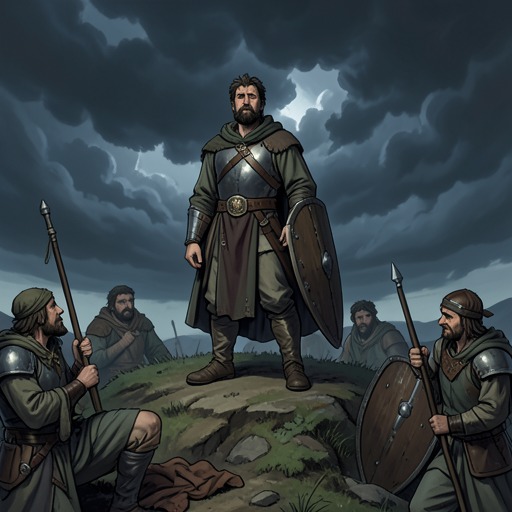
Lucius receives the answer in anger and prepares to invade. He expects to cross the mountains before Easter and move into France, drawing on allied territories and forces. The narrative describes a broad mobilization, including sixteen kings and a large body of soldiers; Lucius also has fifty giants, said to have been born of fiends, assigned to guard him and break Arthur’s battle line. His campaign therefore presents Rome’s claim not as a private quarrel but as an imperial expedition backed by numerous rulers and extraordinary force.
The army advances through lands Arthur has conquered. Lucius reaches Cologne, captures a nearby castle, and places two hundred Saracens or infidels in it. He then devastates other territories Arthur had won from King Claudas. His forces spread across a front reported as sixty miles in breadth, and Lucius orders them to gather in Burgundy, intending to destroy the realm of Little Britain. The movement of the campaign gives substance to his threat: the refusal of tribute is answered by invasion of Arthur’s newly won lands and pressure on his allies.
The Battle of Sessoyne
At Sessoyne, Lucius finds Arthur’s army arrayed against him and his banner displayed. Surrounded, he tells the Romans to fight bravely and invokes Rome’s rule over the world as the reason they must not yield to the Britons. He orders the trumpets sounded, and the armies engage in a long battle whose advantage shifts between the two sides.
Arthur rides through the fighting with Excalibur, going where the Romans are pressing hardest and helping his people. Lucius also fights in person. When Arthur finally reaches him, the two rulers exchange blows: Lucius wounds Arthur across the face, and Arthur answers with a blow from Excalibur that kills the emperor. The Romans then flee, and Arthur’s forces pursue them. The account reports more than one hundred thousand dead on Lucius’s side, after which Arthur orders his own fallen buried according to their rank and directs that the wounded receive medical care and supplies.
Death, Message, and Political Meaning
The aftermath makes Lucius’s death a matter of state as well as battlefield result. Arthur finds several rulers and Roman senators dead with the emperor, including the Sultan of Syria and the kings of Egypt and Ethiopia. He has the bodies embalmed, wrapped in many layers of fine cloth, and placed in lead chests, with their shields, arms, and banners displayed so their origins can be recognized. The defeated leaders are thus treated as identifiable political figures, not left anonymous in the field.
Arthur spares three surviving senators and charges them to carry the bodies to Rome, with a message for the Roman authorities. He calls the dead bodies the tribute Rome had demanded and says that he will bring more when he arrives, while insisting that Britain and the other lands under his rule owe no tax. The reversal is deliberate: the demand for payment has been answered with the emperor and allied rulers sent home as the spoils and proof of defeat. The senators report the scale of the loss and counsel Rome not to make further war on Arthur, presenting his power and the prowess of the Round Table knights as grounds for caution. Lucius’s campaign therefore ends not only with the emperor’s death but with Rome’s immediate military challenge checked and its demand for tribute turned against it.